
When reviewing last week’s data, it’s important to consider various factors. While pending home sales did show some improvement, it may not be as significant as initially perceived. The same goes for new listings and inventory data. Let’s delve into the details.
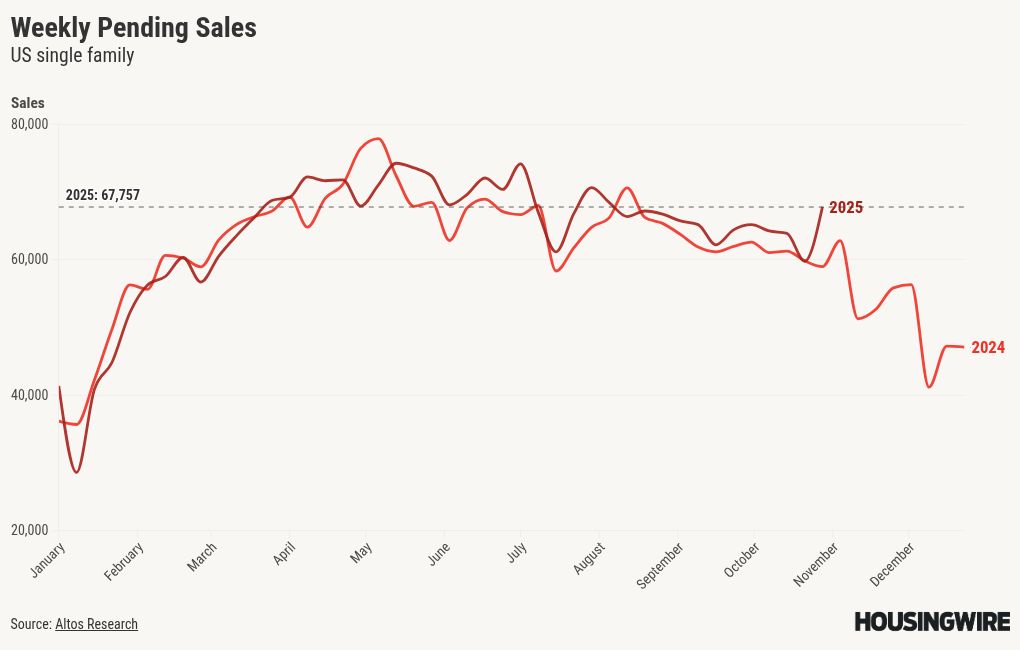
Weekly Pending Sales
The latest report on existing home sales indicated a year-over-year increase in demand by 4.1%.
Several months ago, I mentioned that if sales remained around 4 million, we could expect growth for several months due to low comparisons from the previous year. This trend has continued, with positive year-over-year reports from June to October. The recent uptick in weekly sales data, although not substantial, is a positive sign.
While weekly pending sales have seen an increase, the actual numbers may not be as high as indicated:
- 2025: 67,757
- 2024: 58,966
Similarly, new listings data showed an unusual spike, which is not typical for this time of year. This spike is expected to normalize in the upcoming week. It’s worth noting that most home sellers are also buyers. While the recent stabilization in this data is encouraging, the sudden surge is atypical, mirroring the weekly pending home sales data.
The data on price-cut percentage has shown stability in recent months, with a slight decline noted last week. However, caution is advised when interpreting this data.
Hopefully, we will see some normalization in the data this week, especially amidst the ongoing government shutdown.
Purchase Application Data
Over the past 12 weeks, housing data has been tested with mortgage rates below 6.64%, a crucial threshold in the past. During this period, there have been seven positive and five negative prints, with 12 consecutive weeks of double-digit year-over-year growth in purchase applications.
While it would be ideal to see 12-14 weeks of positive weekly purchase application data to confirm a trend, the past 12 weeks have been the most promising of the year. However, recent week-to-week data has shown some negative trends, possibly influenced by the government shutdown.
- 19 positive readings
- 16 negative readings
- 6 flat prints
- 38 straight weeks of positive year-over-year data
- 25 consecutive weeks of double-digit growth year over year
Weekly Housing Inventory Data
The recent data showing a new yearly high in housing inventory was initially met with excitement, as it suggested a peak in inventory growth. However, the subsequent slowdown in inventory growth has raised doubts about declaring a definitive peak just yet. Inventory growth, which had peaked at 33% earlier in the year, has now dropped to 17.92%, with seasonal declines expected soon.
- Weekly inventory change (Oct. 17-Oct. 24 ): Inventory rose from 859,419 to 867,811
- The same week last year (Oct. 18-Oct. 25): Inventory fell from 739,401 to 735,961
Mortgage Rates and the 10-Year Yield
In the 2025 forecast, expected ranges for mortgage rates and the 10-year yield were outlined. Despite minimal movement in the 10-year yield due to incomplete data from the government shutdown, labor market softness has kept both mortgage rates and yields relatively low. Mortgage rates currently stand at 6.19%, close to the lower end of the forecasted range.
Mortgage Spreads
Mortgage spreads have been a positive aspect for mortgage rates in 2025, nearing normal levels. Historical data suggests that mortgage rates could be significantly impacted by changes in spreads.
The Week Ahead: Fed Week, Bond Auctions, Pending Home Sales, Fed Speeches, and Home Prices
This week is packed with economic news, including the Fed meeting, bond auctions, pending home sales data, Fed speeches, and home price indexes. The Fed’s decision on rates and Jerome Powell’s statements will be crucial, especially given the current low 10-year yield. Bond auctions and pending home sales data will provide further insights into the market.
Stay tuned for updates on home prices, although these reports may reflect changes from a few months ago. With recent shifts in pricing trends, the upcoming reports should make for an interesting week in the housing market.